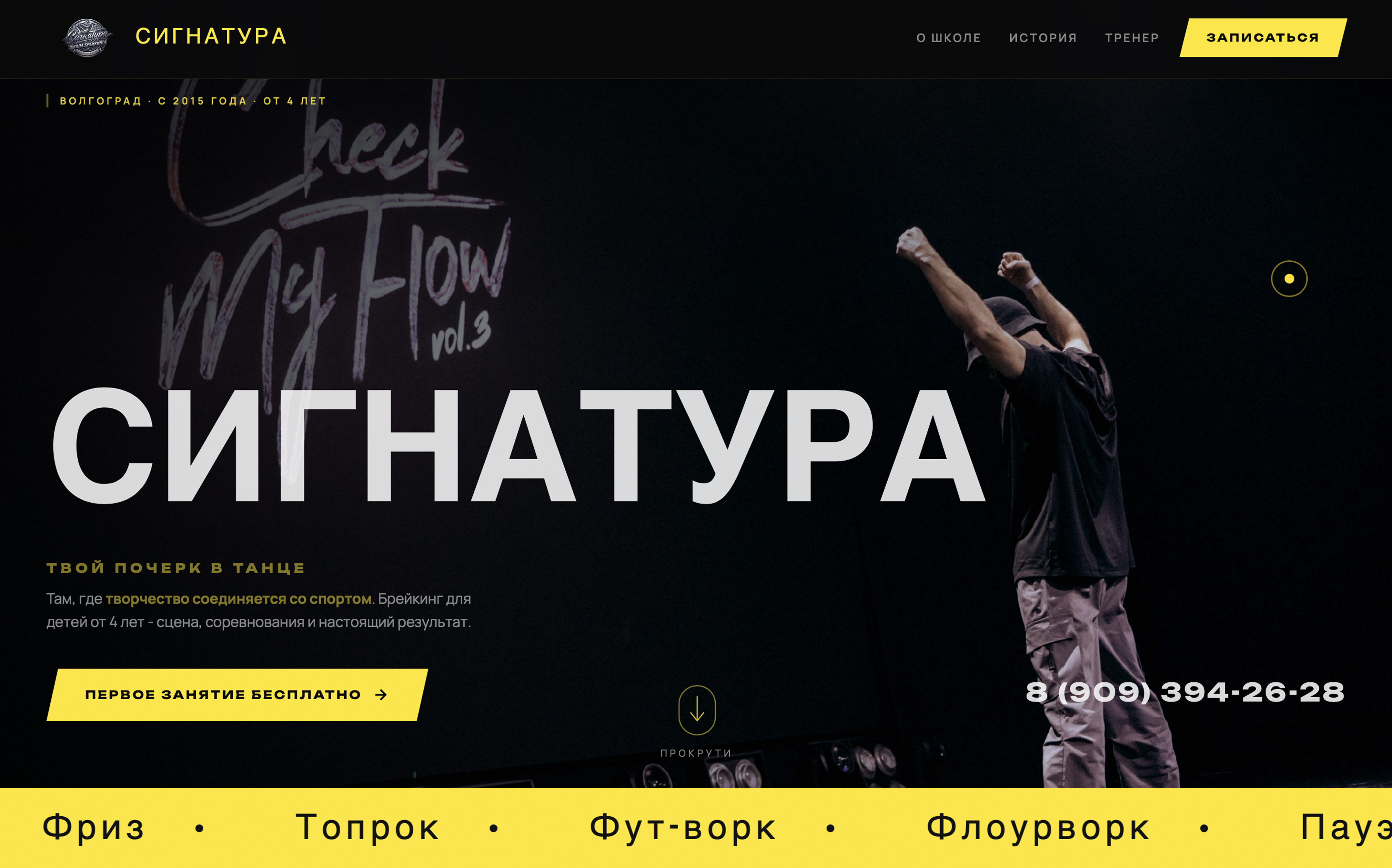
Your signature in dance - Volgograd's breaking school
End-to-end design and development of a first-ever website for a competitive breakdancing school in Volgograd, Russia - converting word-of-mouth reputation into a digital presence that drives free trial class sign-ups for students aged 4 and up.
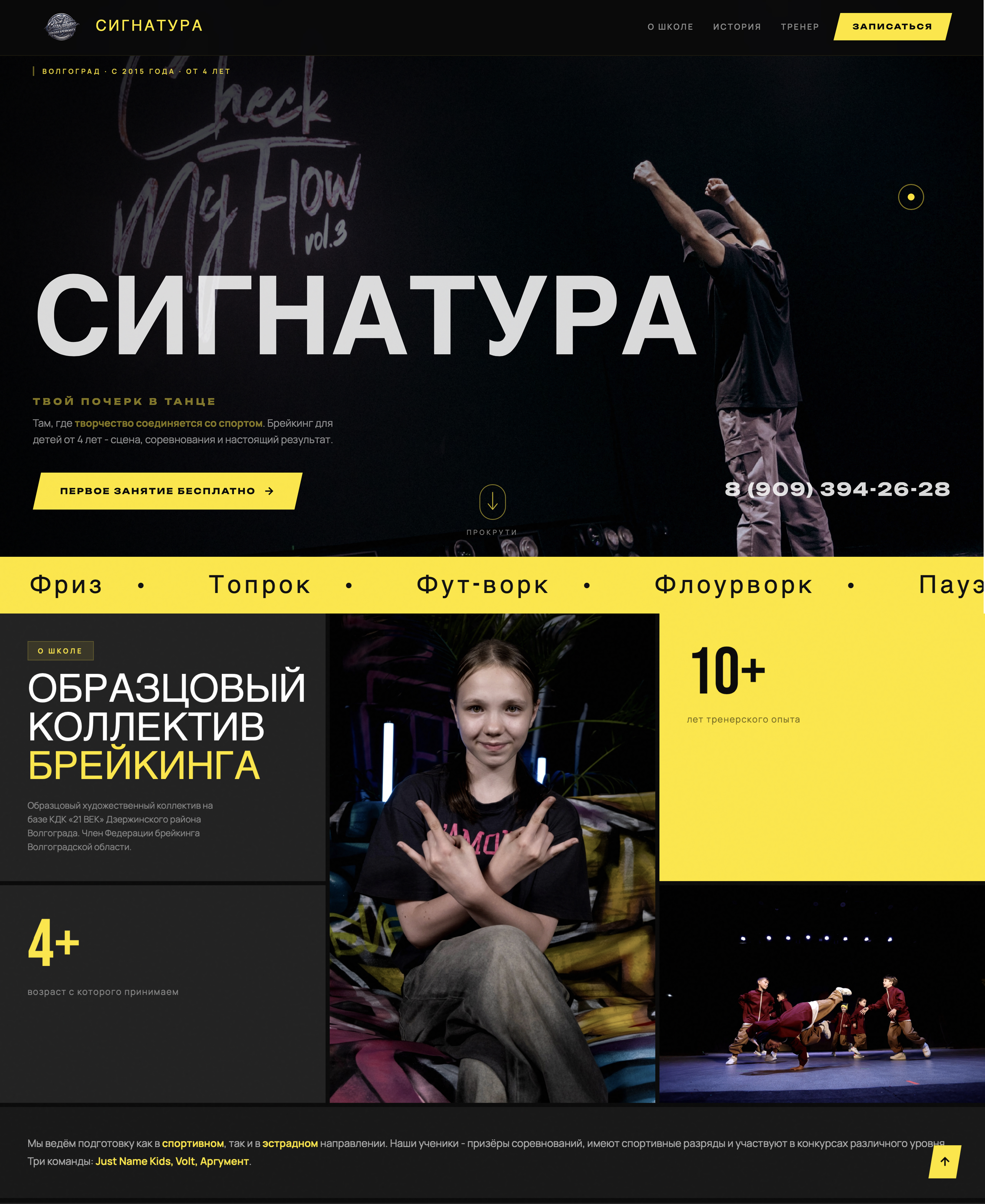
Website screenshot
assets/img/case-img/signatura-hero.jpgA four-phase approach that took a school with zero digital footprint to a live, conversion-focused website - anchored in a real client brief and direct communication with the founder.
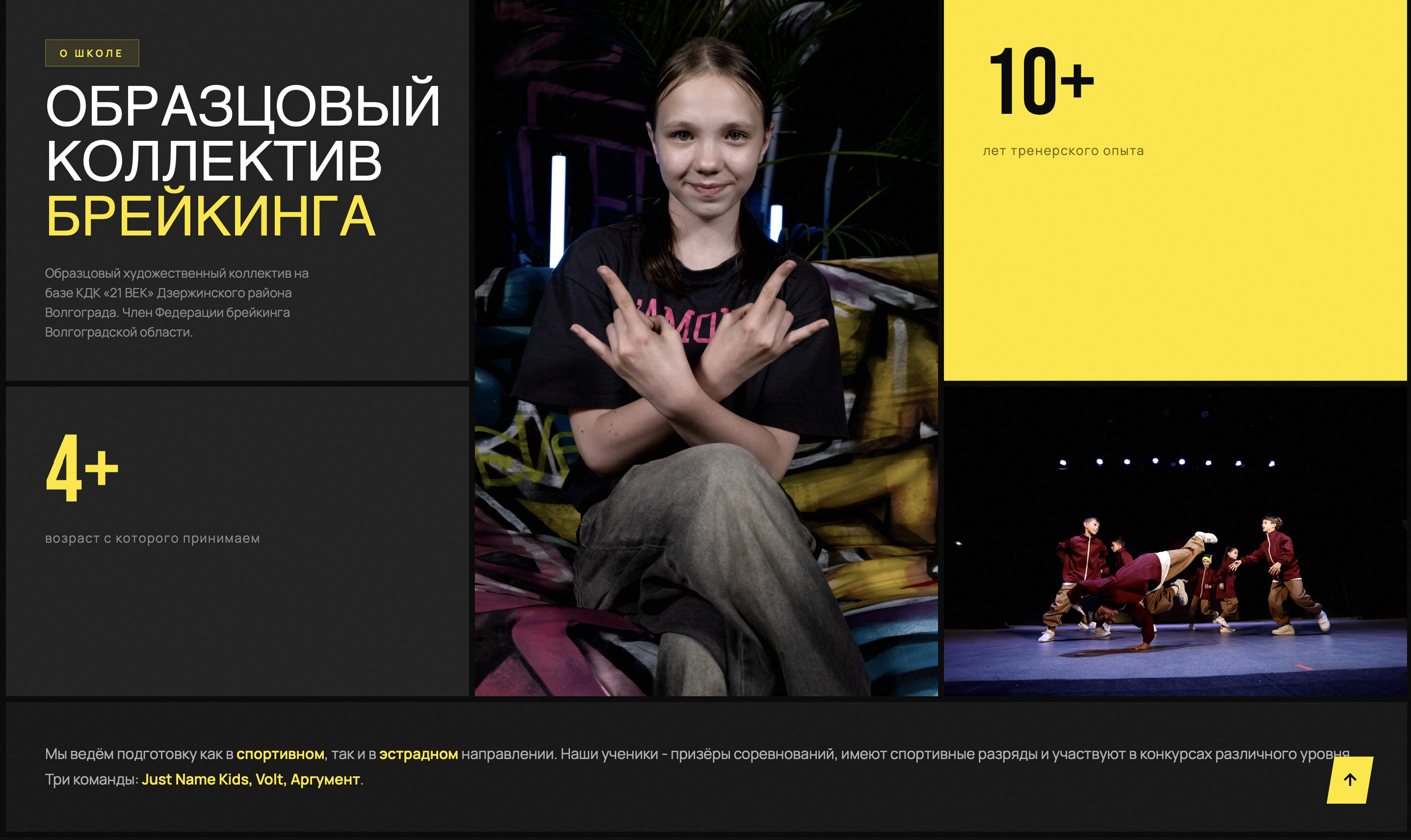
Signatura has been shaping young b-boys and b-girls in Volgograd since 2015. TV appearances, national competitions, a decade of awards - and not a single web page to show for it.
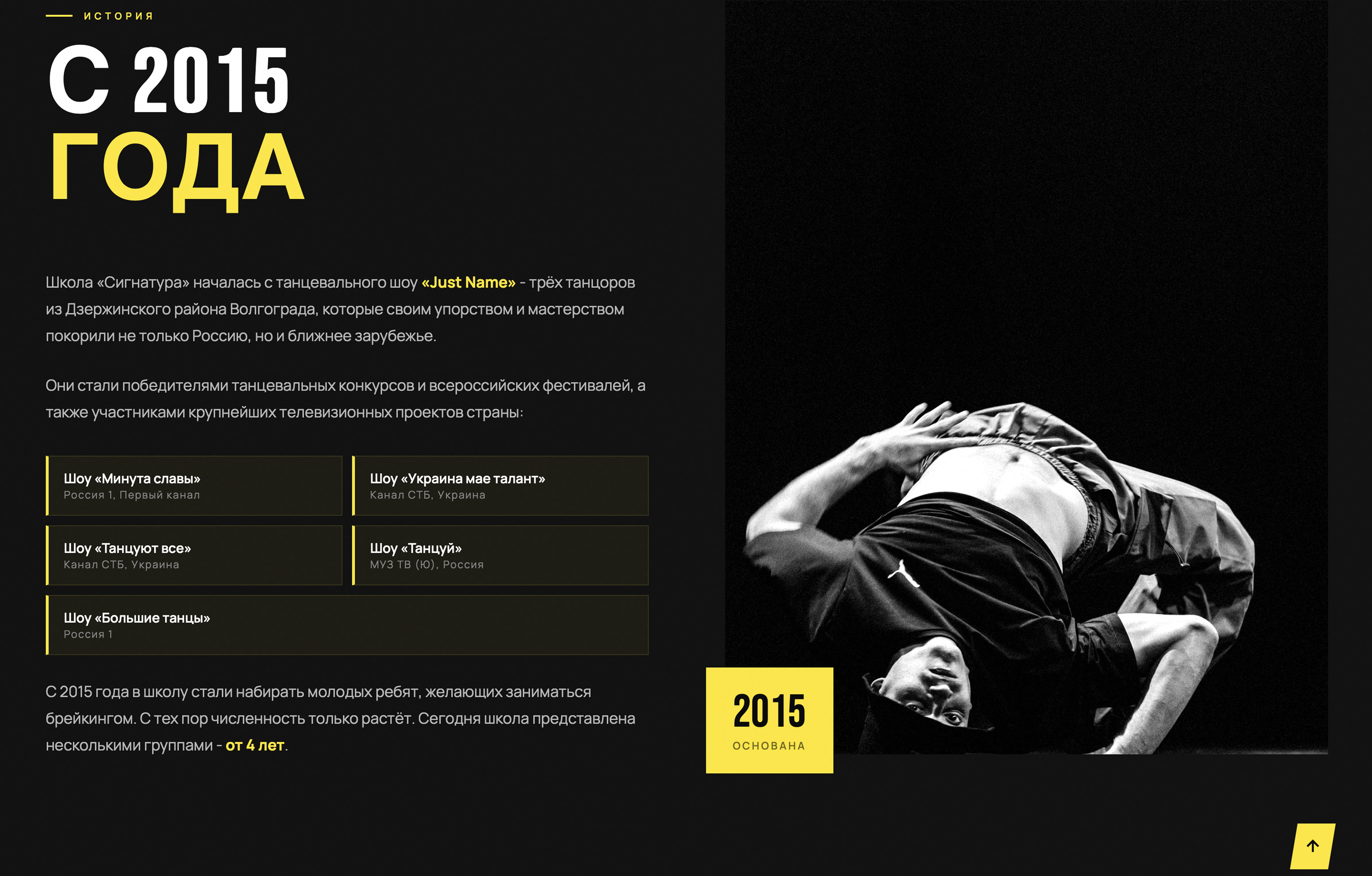
Founded in 2015 inside the Cultural Centre «21 Vek» in Dzerzhinsky district, Volgograd. The founding trio went from local shows to national TV - Minuta Slavy (Channel 1 Russia), Ukraine Got Talent (STB), Tantsuy (MUZ-TV), Bolshie Tantsy (Russia-1).
Parents searching for dance classes in Volgograd found competitors first. The school had no way to show its credentials, showcase results, or let prospective students take the first step independently.
"We want to grow the school and increase its visibility - so we decided to build a website. We never had one before."
- Konstantin Petrenko, Head Coach & Founder · from the client briefThree types of competitors exist in Volgograd's children's dance market. None combined premium credentialing with a clear conversion path to a free trial class.
User types mapped from the brief, competitive research, and the school's actual audience - children from 4 years old, with parents as primary decision-makers.
Three core How Might We questions emerged from research and became the foundation for every structural, visual, and content decision made throughout the project.
Single-page architecture sequenced to answer the visitor's questions in the exact order a parent or teenager would ask them - from "is this real?" to "how do I join?"
The primary conversion flow - a parent who discovers the school online and decides to book a free trial class for their child - mapped out in six steps.
A dark, editorial system - cinematic and bold - that signals competitive seriousness and stands apart from every pastel dance-class brochure in the Russian market.
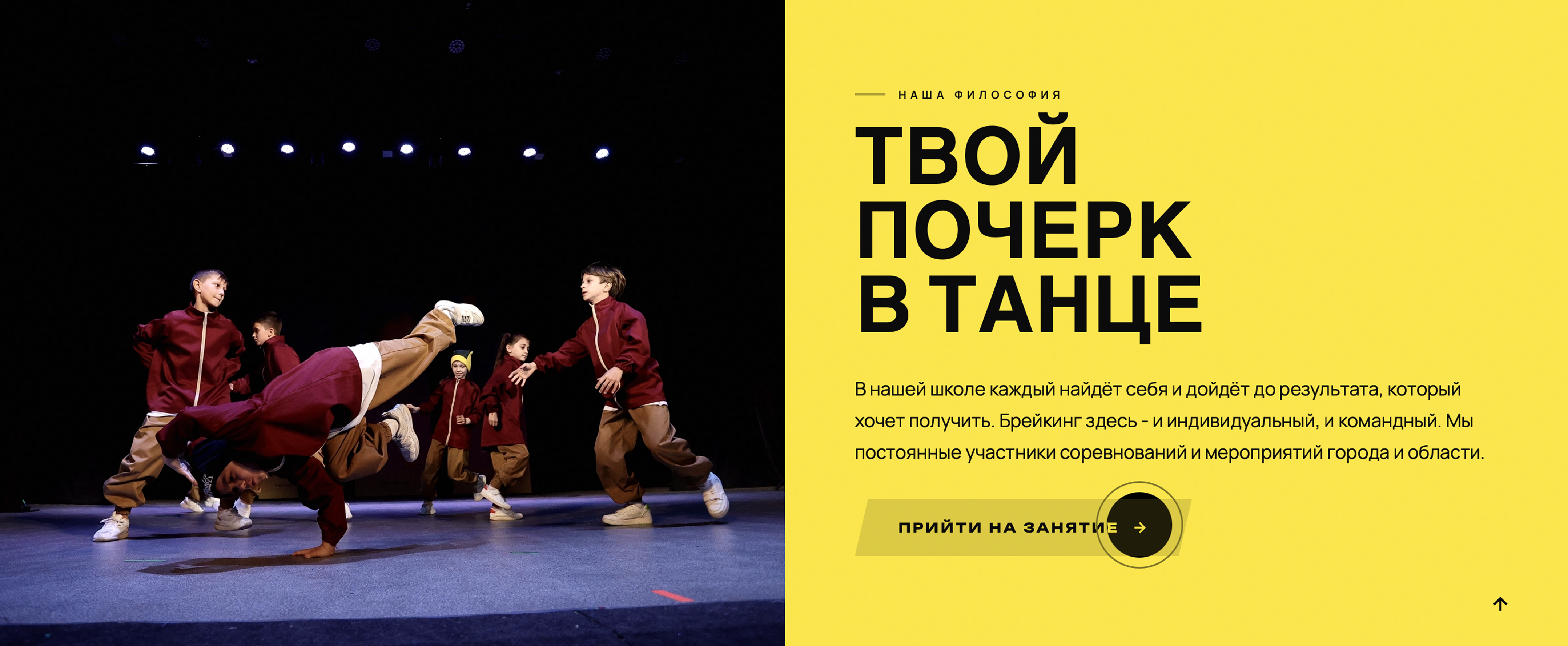
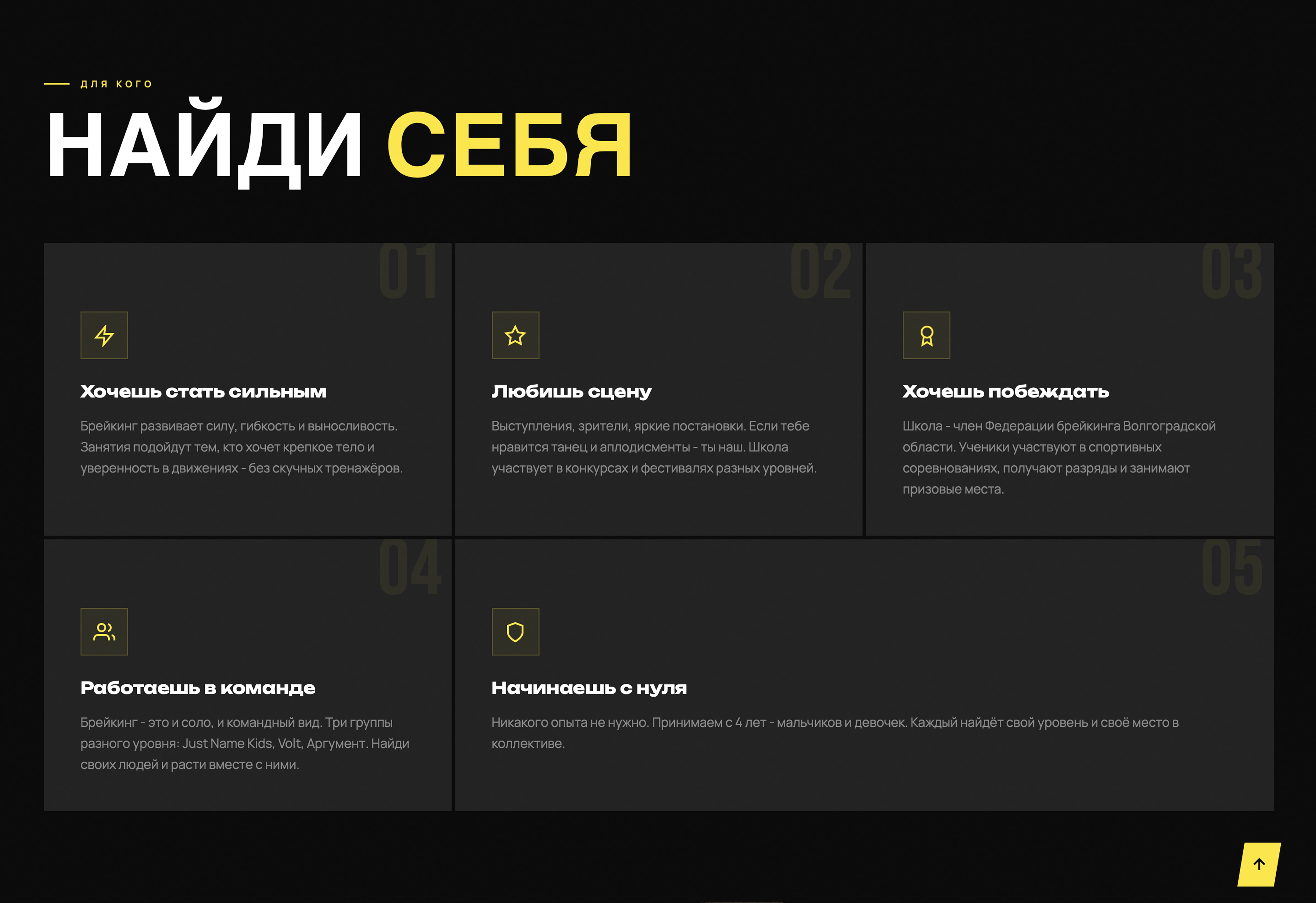
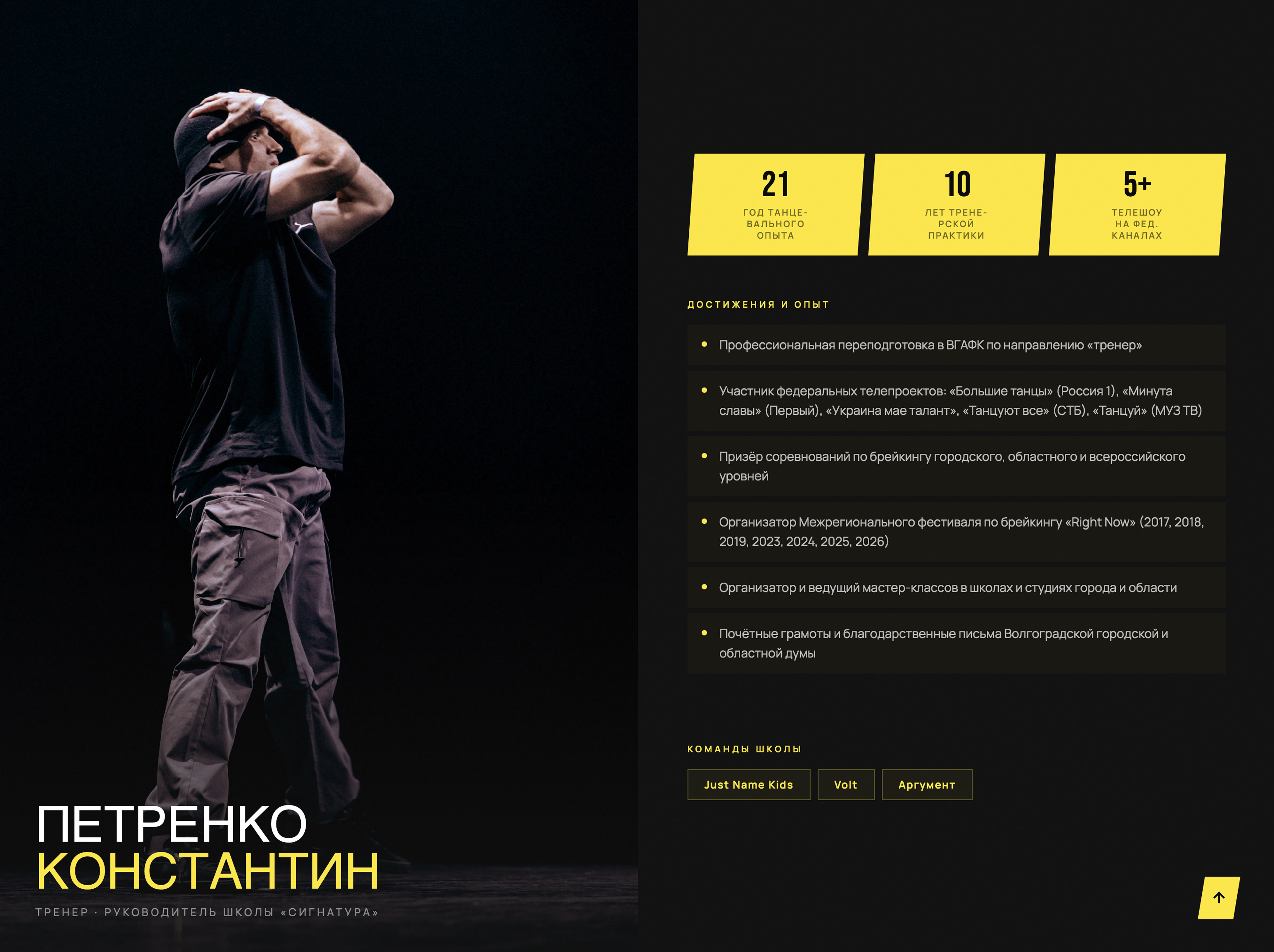
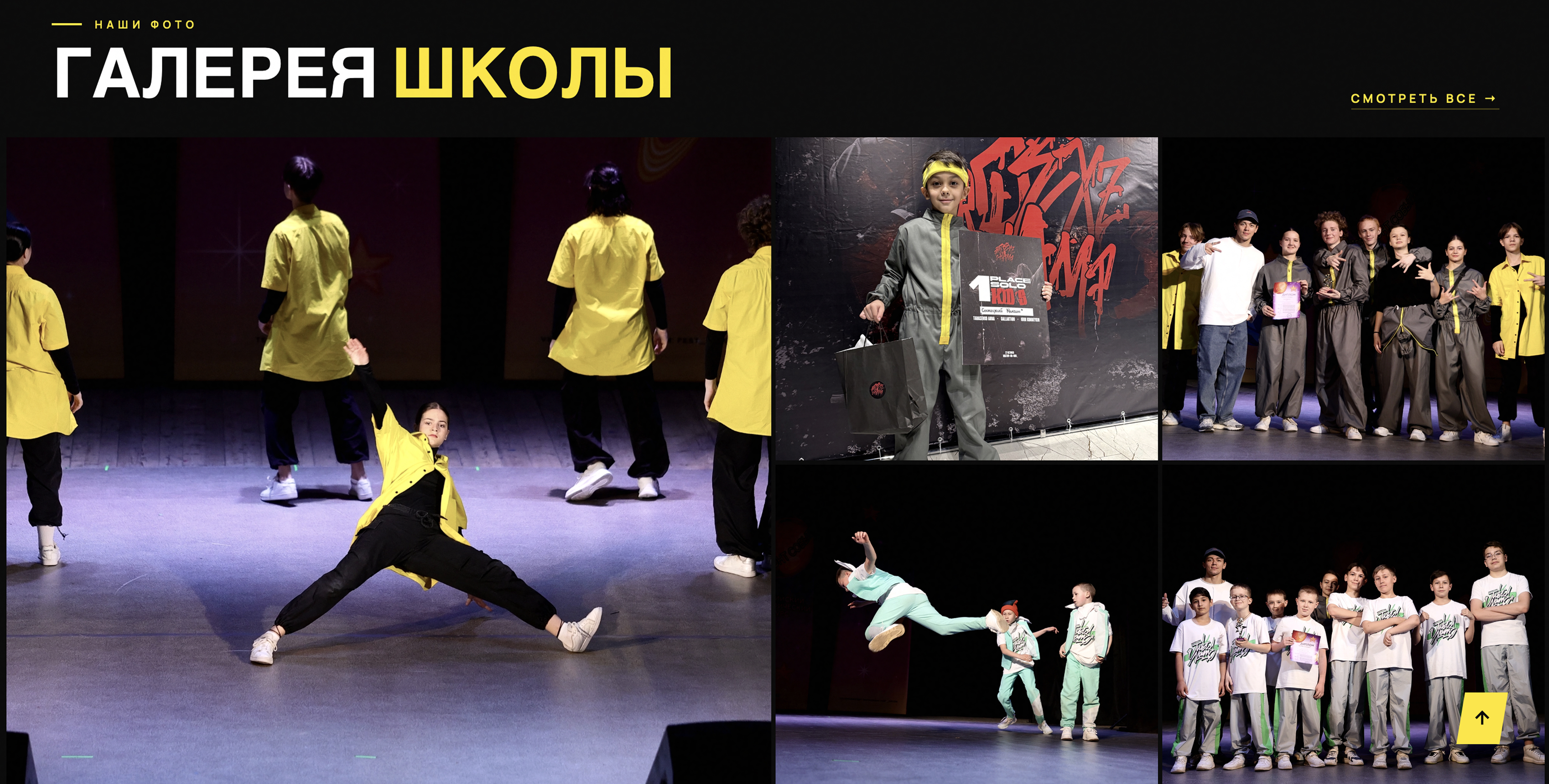
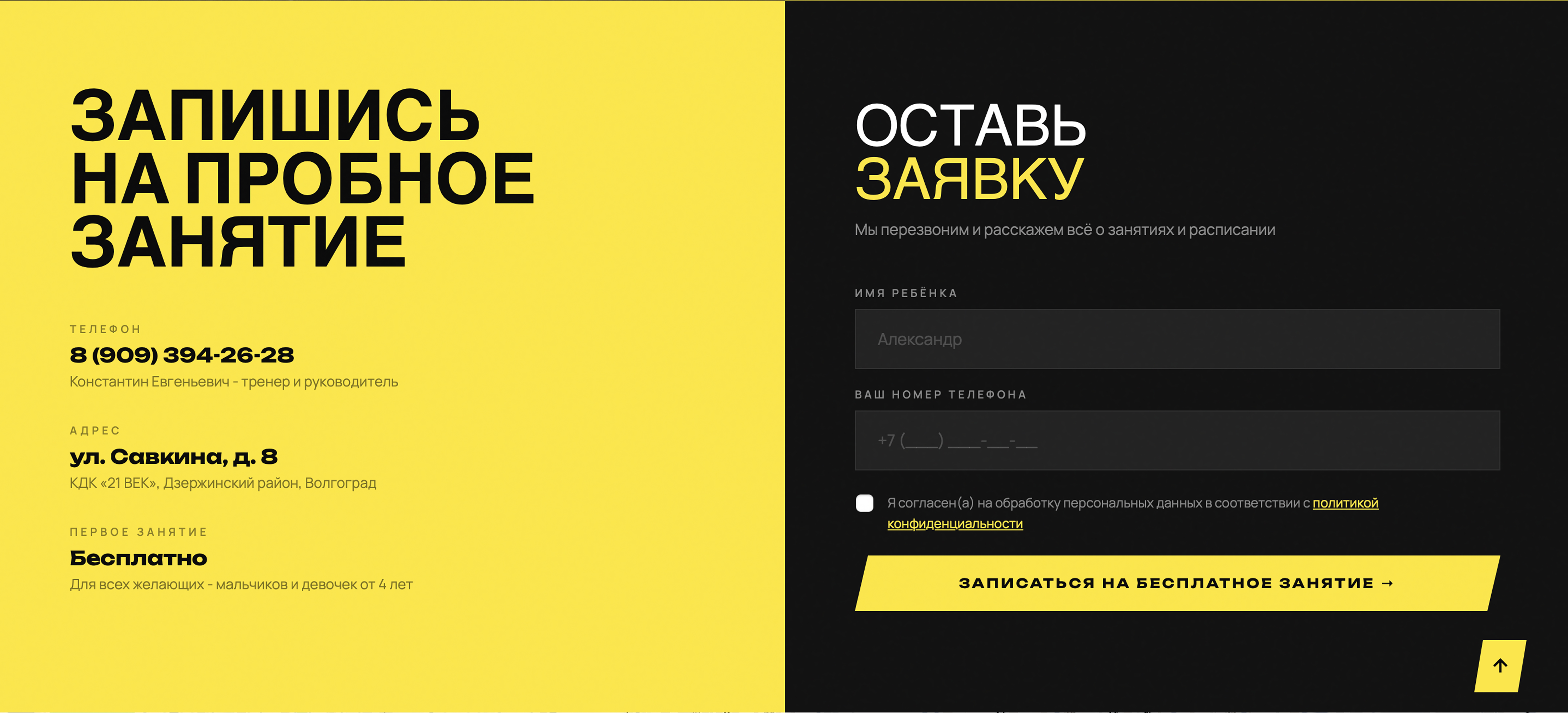
Every section designed to answer a specific question in the parent or athlete's decision journey.
A first-ever web presence transformed Signatura's ability to reach new students - turning a decade of offline reputation into a searchable, conversion-ready digital identity.
Senior design is about decisions under constraints - what got built, what got cut, and why.
The original prototype was built in clean HTML/CSS/JS. Deploying on GitHub Pages would have resulted in slow load times from Russia, potential access issues, and no Yandex.Metrika compatibility - the analytics standard in the Russian market.
Rebuilt on Tilda for production - the dominant Russian landing page platform with Yandex hosting, native analytics integration, and guaranteed fast load speeds. Design fidelity was preserved; the stack was swapped for the audience's reality.
An online form or booking widget would require backend infrastructure and introduce friction the target audience - parents in a mid-size Russian city - does not prefer. Russian service decisions are made over phone calls, not web forms.
The CTA links directly to a phone call. Sticky call button on mobile. No friction, no intermediary. This is not a limitation - it's a cultural design decision that aligns with how trust is built in this market.
Publishing a website in Russia requires specific legal documentation: Privacy Policy (Политика конфиденциальности), User Agreement, and Consent to Personal Data Processing - all compliant with Federal Law No. 152-FZ.
All three documents were authored as part of the project scope - not outsourced. This added time but was non-negotiable for a compliant, professionally delivered product. Included in the handoff package.
The client brief contained only text content - no photos of students, the venue, competitions, or the coach were supplied at the time of design. High-quality action photography is critical for a sports school site.
The layout was architected to be photography-ready - image zones defined, aspect ratios locked, placeholder states designed. The site upgrades dramatically when real photography is added. A photography brief was included in the handoff.
The phone-first CTA, Tilda as the platform, Yandex.Metrika for analytics - none of these are "better" in the abstract. They are correct for Russia. Senior UX is knowing when to set aside global defaults and design from the audience's actual reality.
Writing the privacy policy and user agreement wasn't a box-tick - it was part of designing a trustworthy product. For the Russian market, a site without these documents is incomplete and creates real liability for the client.
Going dark and cinematic when the entire market is light was a deliberate positioning move, not just an aesthetic choice. The visual language said "sport brand" before a single word was read - and that distinction is exactly what the brief asked for.
No photography existed at handoff. Designing photography-ready zones - with defined ratios and placeholder states - meant the site could launch immediately and improve dramatically as real content was produced. Constraints are temporary; architecture isn't.