Case Study

AURA.

A predictive iOS companion for people living with Bipolar Disorder - built to act before episodes escalate.

UX Design UI Design iOS Mental Health Mood Tracking CBT Techniques Healthcare Bipolar Disorder UX Research
Scroll

About

UX Design UI Design Mental Health App Mood Tracking CBT Techniques iOS Mobile Design Bipolar Disorder Support

Aura is a comprehensive mobile application designed for individuals living with Bipolar Disorder. Our core mission was to move beyond simple retroactive tracking to deliver proactive stability and empowered control. It eliminates the user burden of managing multiple applications by centralising key therapeutic and predictive tools.

Aura is built to help users understand their specific patterns, mitigate episode onset, and maintain a stable, predictable daily rhythm.

Project NameAura - Bipolar Disorder Management App
IndustriesHealthcare, Mental Health & Wellness, Digital Health
LocationGlobal
Year2025
PlatformiOS
Screens70+
Design Process

How Aura
came to life.

From a single observed problem to 70+ screens - every phase grounded in evidence, not assumption.

01
Briefing
Problem Space People with Bipolar Disorder lack tools that work on their worst days
02
Research
Evidence-based CREST.BD · NIMH · Harvard · PolarUs · Reddit r/bipolar · App Store reviews
03
UX Design
Architecture first IA · User flows · Jobs to Be Done · 8 pain points · CJM
04
UI Design
70+ screens iOS HIG · 5 tabs · Onboarding · Safety · Insights
05
Swift
Dev
Coming next Native iOS development in Swift
Grounded in academic research - NIMH, Harvard, CREST.BD
Validated against real community voices - r/bipolar, App Store reviews
Designed to iOS Human Interface Guidelines
5 core tabs - Zero redundant navigation
02 - The Challenge

Living with Bipolar Disorder is a full-time job - but tools haven't kept up

73% of individuals miss early warning signs. Apps demand too much, deliver too little, and fail exactly when people need them most.

0%

of people with Bipolar Disorder miss early warning signs before an episode begins - they physically cannot see it in themselves

73%
miss signs
0%

maintain tracking beyond 3 weeks on existing apps - abandonment spikes to 92% during depressive episodes, when data is needed most

23%
stay active
0–6

separate apps required to track a complete health picture - sleep, mood, medication, caffeine, journalling, and tasks all fragmented

4–6
apps used
0min

average monthly face time with a psychiatrist - the only clinician who sees the full picture sees almost nothing of the actual lived experience

15m
per month

Pain 02 - Highest Priority

I always abandon tracking after a week

During depression there's no energy to open an app. During mania - it doesn't feel necessary. Complex forms with 10+ fields are impossible during acute episodes, precisely when data is most critical. Apps built for good days fail on bad ones.

"I've tried every tracking app. I always stop. The effort required just isn't there when I'm struggling the most."

- r/bipolar community · PolarUs Research, 2025
0%
continue
past 3 weeks
Continue tracking - 23%
Abandon before 3 weeks - 77%
During depression - drops to 8%

Pain 03 - High Priority

My data is scattered across 4–6 apps

Sleep patterns, caffeine, medication, mood - all in separate apps. Correlating data across applications is cognitively impossible during acute episodes. Without synthesis, patterns remain invisible.

"I have a sleep app, a mood app, a medication reminder, and a journal. None of them talk to each other."

Sleep App
Mood Tracker
Med Reminder
Journal
Caffeine Log
Calendar
Zero data sharing between apps

Pain 04 - High Priority

In a crisis, I don't know what to do

Even with a written crisis plan, recalling emergency contacts, action steps, and stabilising techniques during an acute episode is near-impossible. The critical 24-hour intervention window closes while people search through apps.

"I wrote out my whole crisis plan with my therapist. When I needed it, I couldn't find it or remember what it said."

⚠️
Episode begins

Early signs: irritability, reduced sleep, racing thoughts

😰
Cognitive impairment activates

Can't think clearly. Memory of the plan is inaccessible.

📱
Searching across multiple apps

Contacts in one app. Plan in another. No quick path.

🚨
Critical window missed

Episode escalates. Intervention opportunity passed.

Early intervention reduces severity by up to 60%
03 - User Research · Personas

Two people.
One shared struggle.

Profile A

The Stabiliser

Bipolar I or II · Living with diagnosis 3+ years

Primary goalMaintain stability between episodes
Trigger momentPrevious episode - "I need to take control"
Biggest fearNot noticing the next episode starting
Doctor visits15 min/month - can't show full picture

Core pain points

Can't see episode onset - impaired self-insight
Loses tracking habits during depressive phases
Forgets everything at the 15-minute appointment

"I've been managing this for 6 years. I should know my patterns - but I still can't see it coming."

- Profile A · Composite voice
Profile B

The Newly Diagnosed

Any BD type · Diagnosed less than 1 year ago

Primary goalUnderstand the disorder, learn to live with it
Trigger momentShock of diagnosis + dissatisfaction with treatment
Biggest fear"Am I feeling this, or is it the disorder?"
Doctor visitsStill establishing trust - overwhelmed by info

Core pain points

Can't trust own perception - "Is this real or mania?"
Overwhelmed by complex apps with 10+ field forms
Family doesn't understand - feels isolated

"I was diagnosed three months ago. I don't know what 'normal' feels like for me yet - how do I notice when it's off?"

- Profile B · Composite voice
04 - User Flow

Designed for the worst day.

Every flow stress-tested for the moment when cognitive load is highest and motivation is lowest.

A - DAILY CHECK-IN Push notification App opens Home screen Quick Check-in mood · sleep · meds · <60s All fields filled? Yes Entry saved · Dashboard updates No Full Check-in modal emotions · triggers · notes Saved to Journal B - SELF-CHECK & CRISIS ACCESS Home screen User sets own level no auto-diagnosis 🟢 Calm - no action 🟡 Watch out 🔴 Act now Safety tab crisis plan · contacts 1-tap call Floating SOS button persistent on every screen bypasses all navigation C - MEDICATION LOG Reminder push Med status block today's medications Tap "Taken"? 1-tap confirmation Yes Marked ✓ 7-day adherence updates No Skip logged reason optional Doctor's report included automatically D - DOCTOR'S REPORT Insights tab Doctor's Report tap in Insights Select period 7 / 30 / 90 days PDF generates preview before export Email to doctor AirDrop / Share Print
05 - Customer Journey Map

From diagnosis
to daily stability.

Mapping every touchpoint, emotion, and opportunity - and where Aura intervenes at each critical moment.

Awareness
Realising help is needed
Onboarding
First 3 minutes
Daily Use
Regular check-ins
Crisis
Episode begins
Long-term
Ongoing stability
Actions Reads App Store reviews · checks screenshots · asks in r/bipolar Selects BD type · optionally adds meds · sets check-in time Daily mood + sleep + meds check-in · marks meals · logs caffeine Taps SOS → opens Crisis Plan → uses breathing → calls psychiatrist Generates PDF for doctor · reviews 90-day Insights · shares data with care team
Touchpoints App Store listing · peer recommendation · psychiatrist referral Welcome → Profile → Meds (optional) → Reminders → Triggers Push notification → Quick check-in → Home EWS → Care tab Floating SOS button → Safety tab → Crisis plan / CBT / 1-tap call Insights tab → Doctor's Report → PDF → Email / AirDrop / Print
Thinking "Will this be different to other apps I've tried and abandoned?" "This is actually short. I can skip what I don't know yet." "The alert makes sense - I didn't sleep well 3 nights in a row." "I can't think clearly but the button is right there. I just follow steps." "My doctor finally has the full picture for the first time."
Emotions ScepticalHopeful CautiousRelieved In controlSeen ScaredLess alone ConfidentEmpowered
Experience
Pain Points Complex app comparisons · fear of abandonment · stigma around tracking Long onboarding · mandatory fields feel intrusive Form fatigue · missing check-ins · no visible insight payoff Can't find crisis plan · multiple taps · cognitive overload Doctor doesn't understand day-to-day experience
Opportunities ↑ Lead with simplicity↑ Peer social proof ↑ <3 min onboarding↑ Skip-everything ↑ EWS hero feature↑ <60s check-in ↑ 1-tap SOS↑ Pre-written plan ↑ PDF Doctor's Report↑ 90-day Insights
Aura Response Clean App Store presence · clear value proposition · <3 min promise 5-step onboarding · all optional except BD type · no guilt messaging Quick Check-in <60s · EWS on Home · auto-pattern analysis Persistent SOS button · Safety tab opens instantly · pre-written plan PDF report generator · Insights 7/30/90d · export & share with care team
06 - The Solution

Not just a tracker. A system that acts before you do.

Three interlocking answers to four interconnected problems. Built around the hardest days, not the easiest.

Solution 01

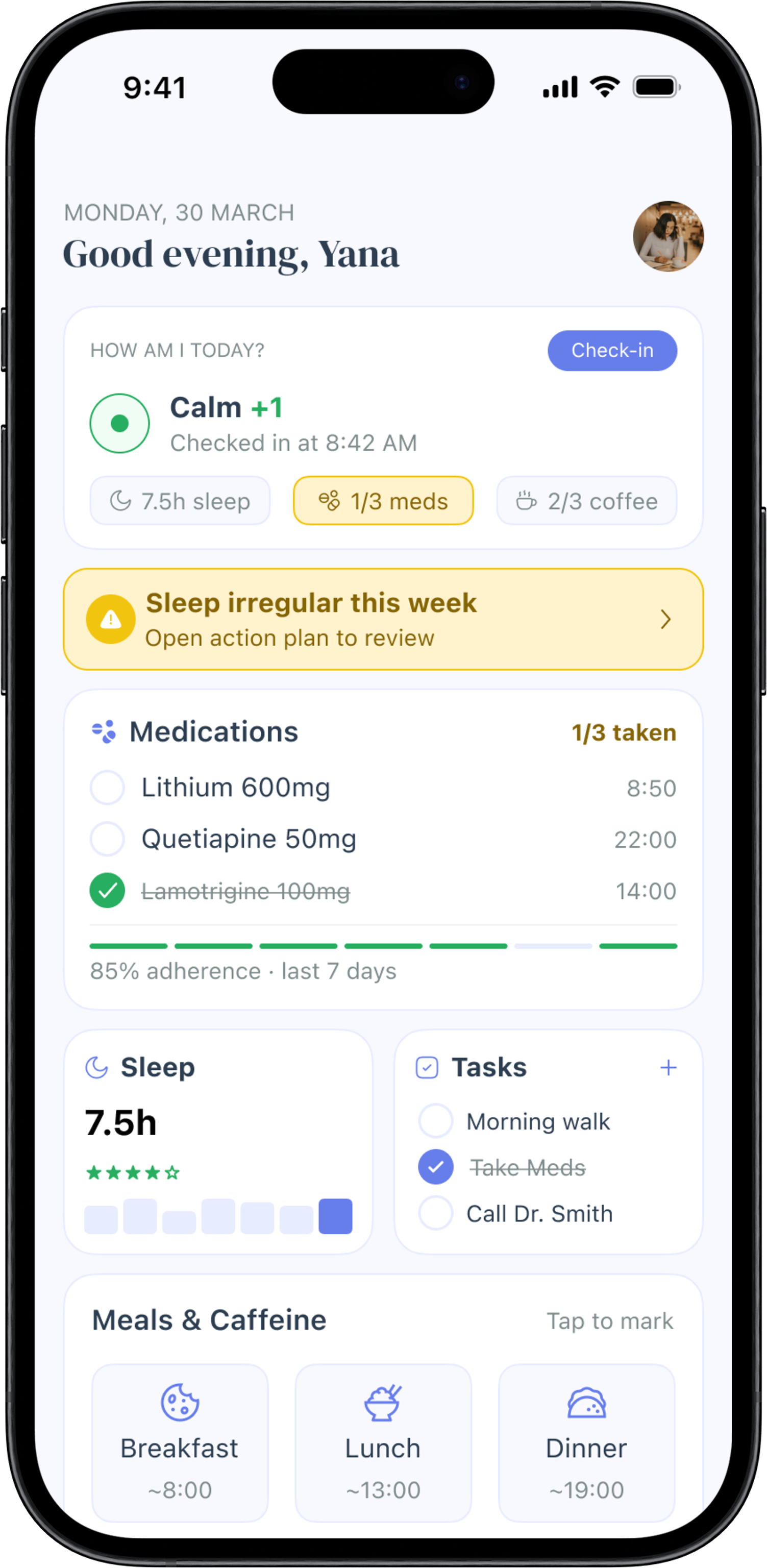
Predictive Early Warning System

Aura cross-references mood logs with sleep debt, medication adherence, meal regularity, and caffeine. When multiple risk factors converge, the system surfaces a time-sensitive alert on the main dashboard - 24–48 hours before episodes typically escalate.
24h
Earlier detection
60%
Severity reduction
Sleep monitoring Medication tracking Caffeine logger Risk scoring Personalised thresholds
Dashboard with EWS alert
Insights-correlation-chart

Solution 02

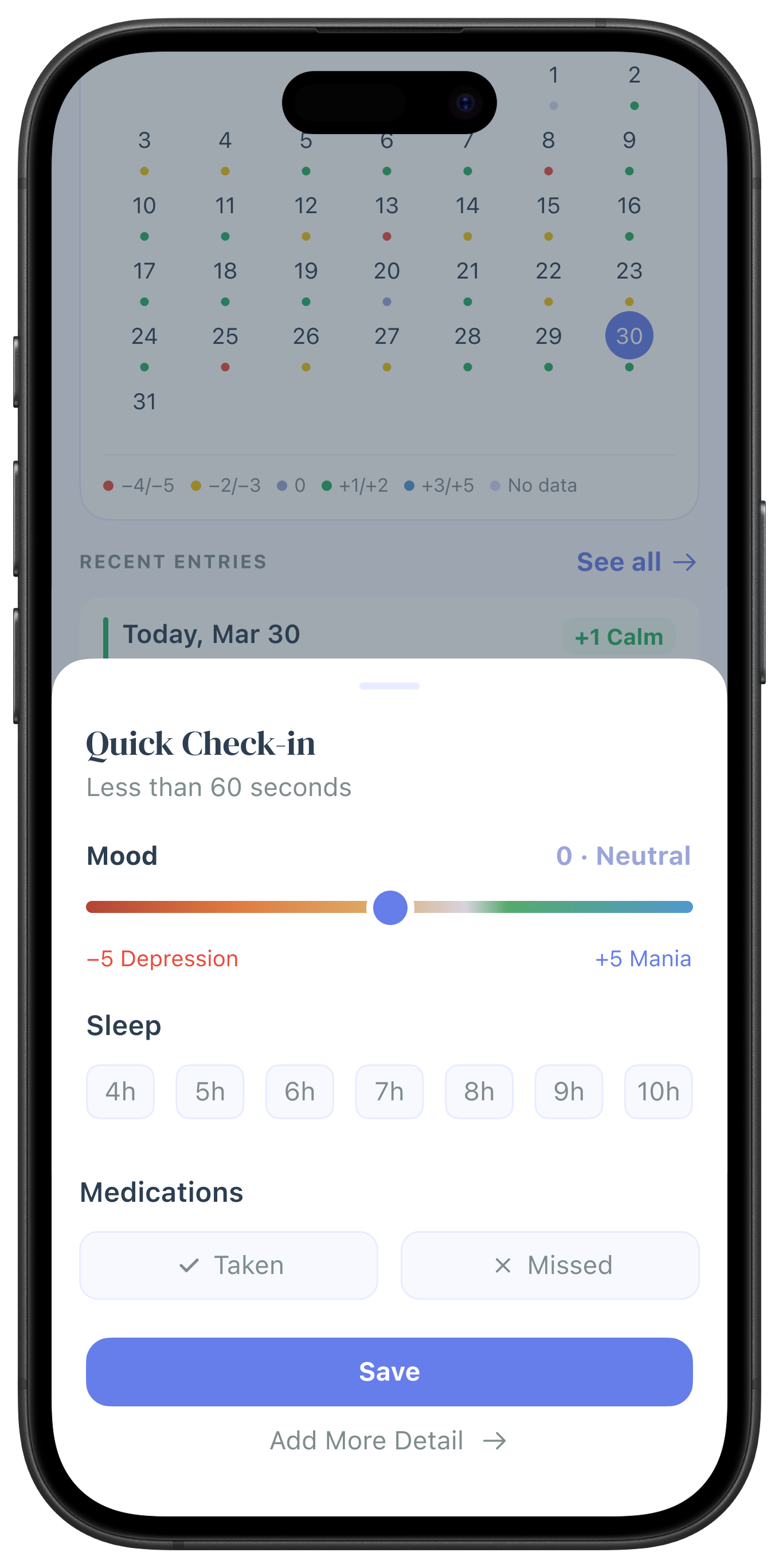
Unified Routine & Stability Hub

Rather than splitting mood tracking from daily management, Aura integrates everything into one frictionless interface. Medication reminders, sleep tracking, meals, caffeine, tasks - all alongside mood. Eliminates 4–6 separate apps. Daily check-in takes under 60 seconds.
4–6
Apps eliminated
<60s
Daily check-in
Quick check-in Medication manager Sleep tracker Meal logging To-do list
Home dashboard
Quick-check-in-modal

Solution 03

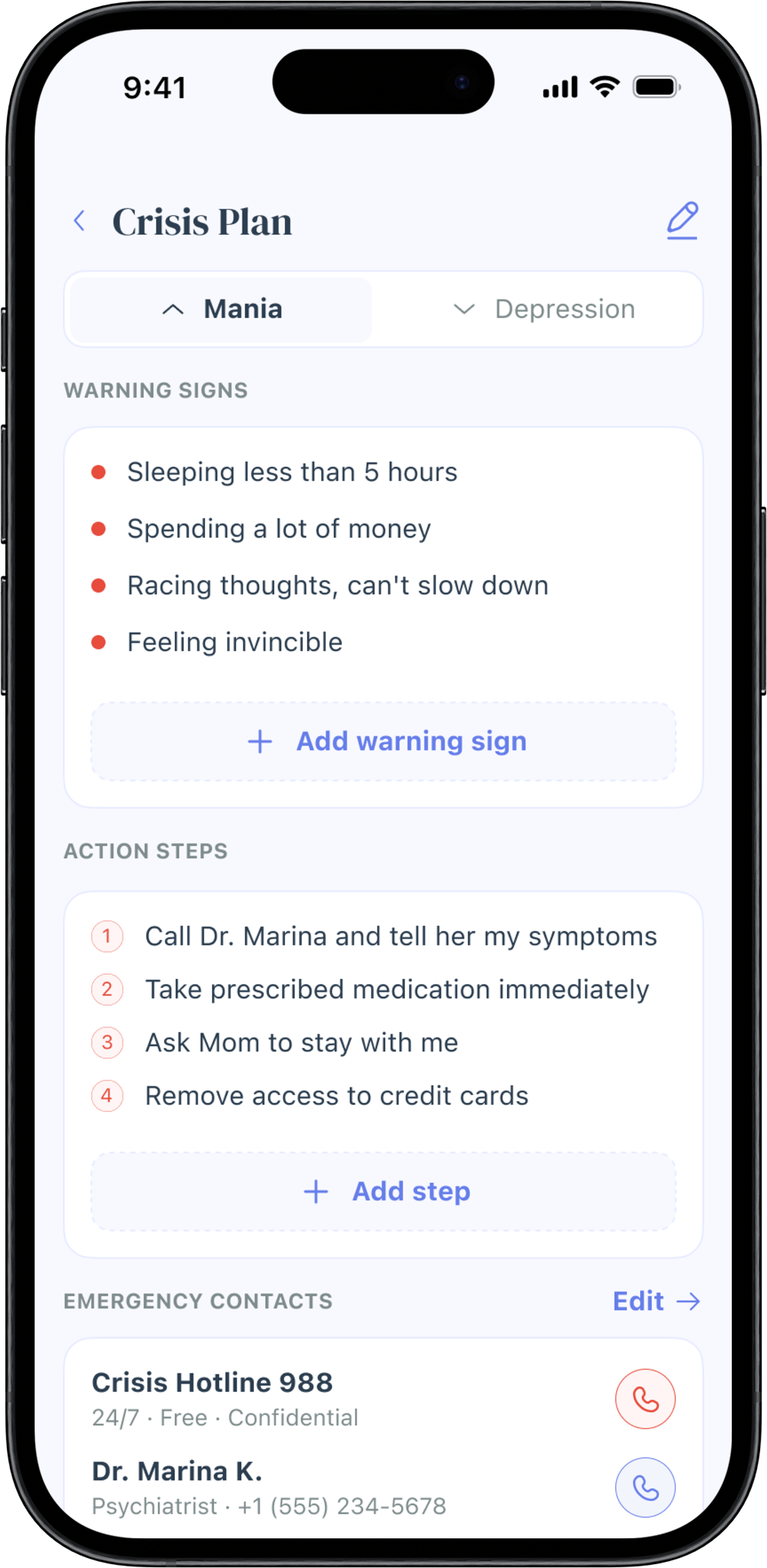
Immediate Crisis Intervention Toolkit

Written on a good day. Accessible on the worst one. Personalised crisis plans, one-tap emergency calls, CBT techniques, breathing exercises, and grounding tools - all behind a persistent floating button reachable from anywhere in the app. No navigation. No menus. Instant.
1 tap
Crisis access
5–10m
De-escalation
1-tap crisis access Personalised action plan Emergency contacts CBT cards Breathing exercises Grounding techniques
Safety tab-crisis plan
Breathing-bubble-exercise
07 - Design Impact

Designed to close the gap between episode and insight.

0+
screens across 5 tabs, onboarding & settings
<60s
daily check-in completable during depressive episodes
0
tap to access crisis support from anywhere in the app

Every decision, every flow, every interaction was designed for your hardest day - not just your best one.