An English school built for Russian-speaking Europeans
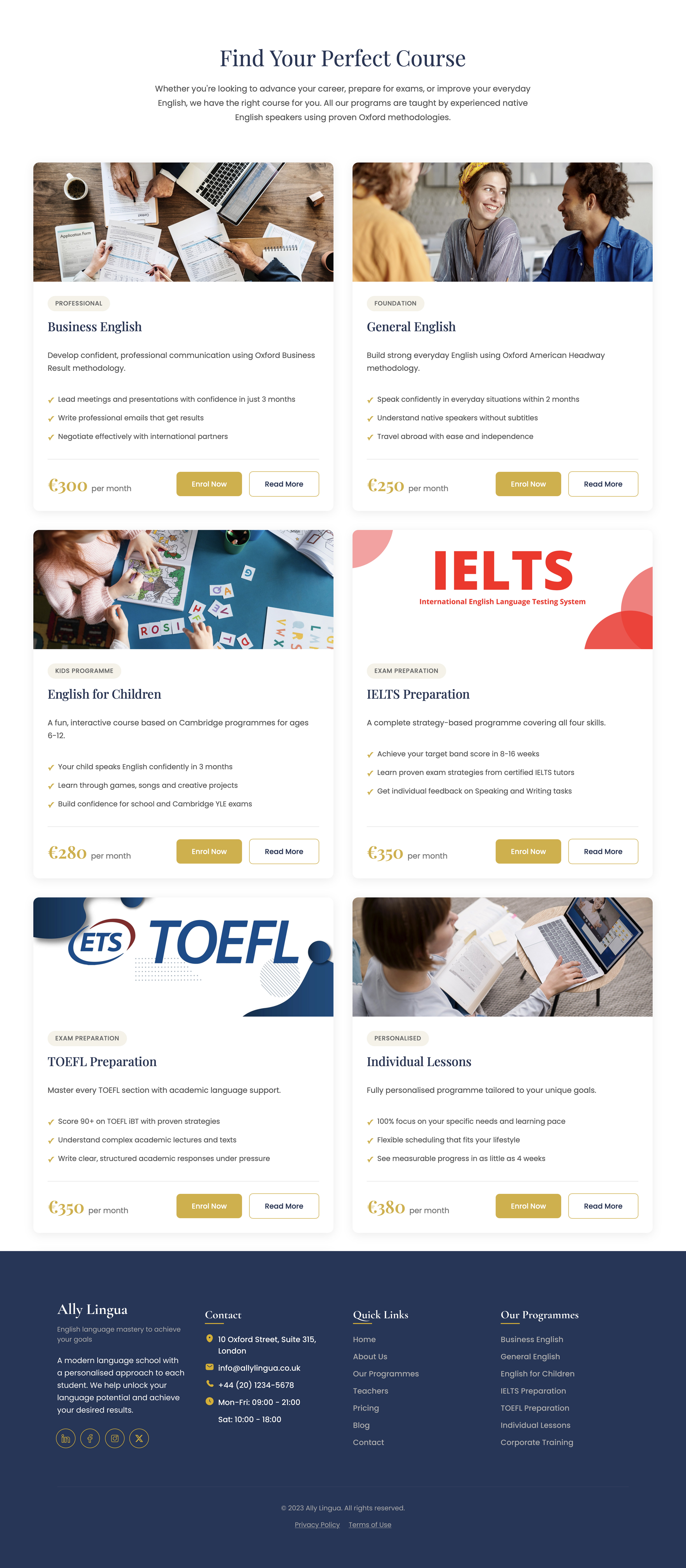
End-to-end design and development of a premium bilingual online school -- from zero brand identity to a live, conversion-ready website targeting Russian-speaking expats across the EU.
From community observation and expat interviews to a live bilingual website -- every phase grounded in real audience needs, not assumptions.
Ally Lingua existed as a concept -- a personal idea for an English school aimed at Russian speakers in Europe. No brand. No website. No digital presence of any kind. The brief was to build everything from scratch and launch a product that could compete with established schools from day one.
Over 4 million Russian speakers live across EU countries -- many arrived post-2022, needing English urgently for work, healthcare, and daily life. Existing English schools do not speak their language, literally or culturally.
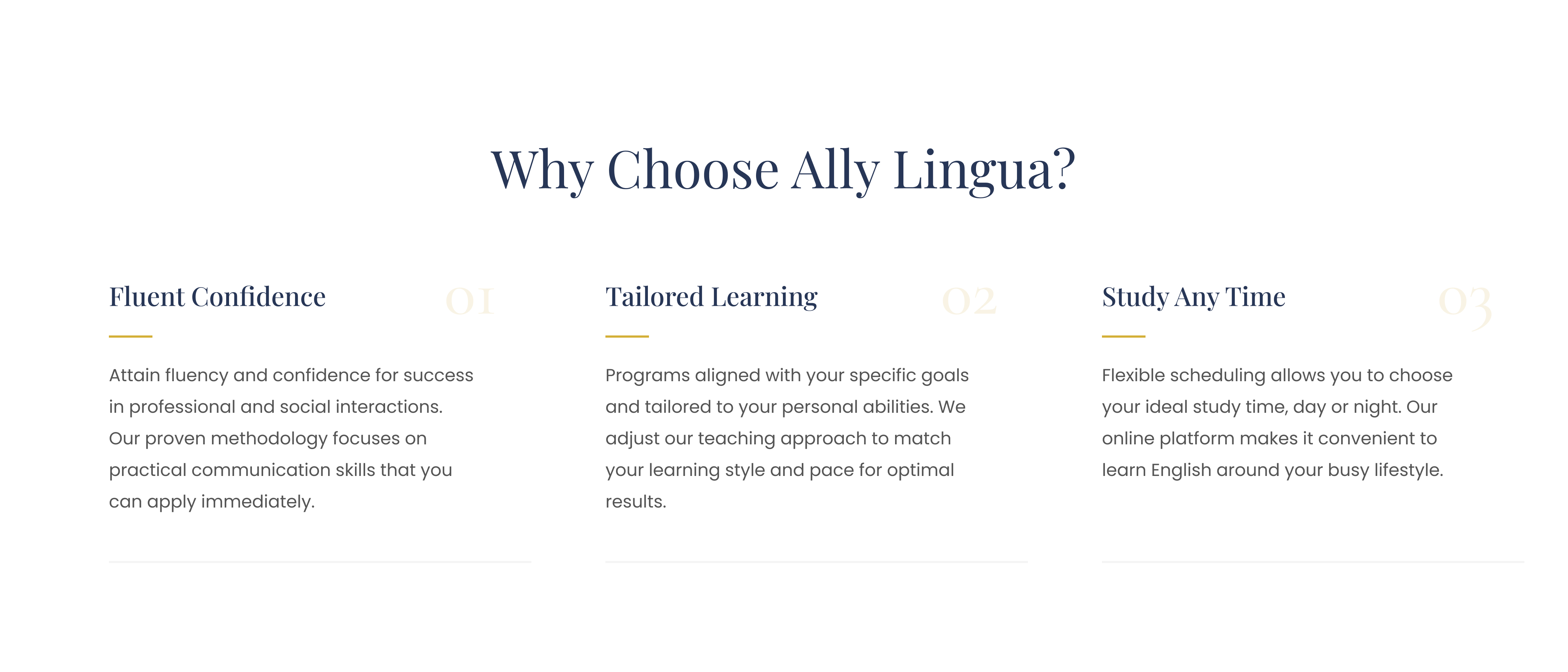
The design had to work on three levels simultaneously: build trust fast, guide users to the free trial, and leave no legal gaps for an EU audience. Every section earned its place by serving at least one of these goals.
Before designing, I benchmarked three comparable online English schools targeting expats or non-native speakers -- to understand what made their digital presence trustworthy, and where the category consistently fails.
Massive teacher marketplace with strong social proof -- thousands of verified reviews and granular filters. However the experience feels like a marketplace, not a school. No warmth, no brand voice, no cultural understanding of the Russian-speaking expat who is not just looking for a tutor but for a trusted guide.
The dominant RU-language EdTech product -- but built for Russia, not for Europeans. EU-based users face currency friction, time zone mismatches, and content calibrated for life in Russia. The brand does not address the expat identity: living between two cultures and needing English as a bridge to the new one.
Teach English to Western European locals. No Russian-language communication, no acknowledgement of the migrant context. Trust signals are calibrated for a different audience entirely. This leaves a clear and underserved gap: a premium, culturally fluent English school for the Russian-speaking EU diaspora.
The gap in the market is not about teaching quality -- it is about cultural positioning. No online school speaks Russian, understands the expat experience, and offers a premium product built around that identity. Ally Lingua was designed to own that space.
-- Research insight · Ally Lingua · 2024Research was conducted through community observation in Russian-speaking Telegram and Facebook groups, and through first-hand experience living across South Korea, Portugal, and France -- giving direct access to the expat mindset that no secondary research could replicate.
The primary flow maps how Masha -- the career-focused persona -- moves from social discovery to booking a free trial lesson. Pain points from the old non-existent flow become design opportunities in the new product.
| Discovery | First Impression | Explore | Decision | Booking | |
|---|---|---|---|---|---|
| Action | Sees Instagram post or Google result in Russian | Lands on homepage, reads value prop and teachers section | Goes to Courses page, selects Business English tab | Reads teacher profiles, checks credentials and specialisations | Fills in free trial form -- 5 fields -- and submits |
| Thinking | "Let me see if this is different from other schools" | "This looks serious. And it is in Russian -- finally." | "Business English -- yes, that is exactly what I need" | "Sarah speaks Russian and has corporate experience. She gets it." | "Free trial, no commitment -- ok, I will try" |
| Feeling | 😐 | 🙂 | 😊 | 🤩 | 🤞 |
| Pain points | OLD FLOW No website existed -- Instagram bio linked nowhere |
-- | Risk Generic courses with no differentiation cause drop-off |
Trust gap No reviews yet -- profiles must do the trust work alone |
Friction Long form or phone-only CTA loses mobile users |
| Opportunities | Fixed Live website as destination for all social traffic |
Designed Russian-language hero builds trust before any mention of prices |
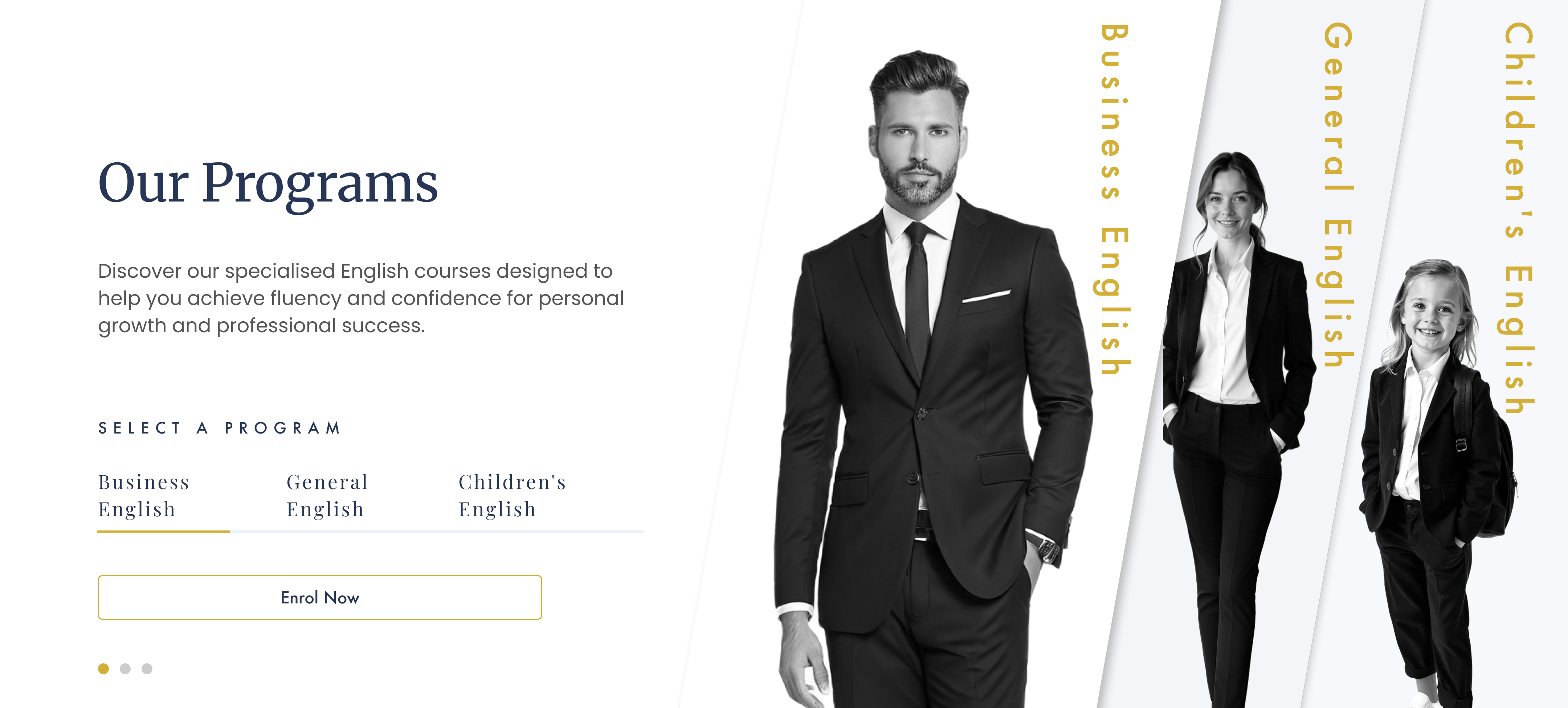
Designed 3 clear tracks -- Business, General, Children's -- no decision paralysis |
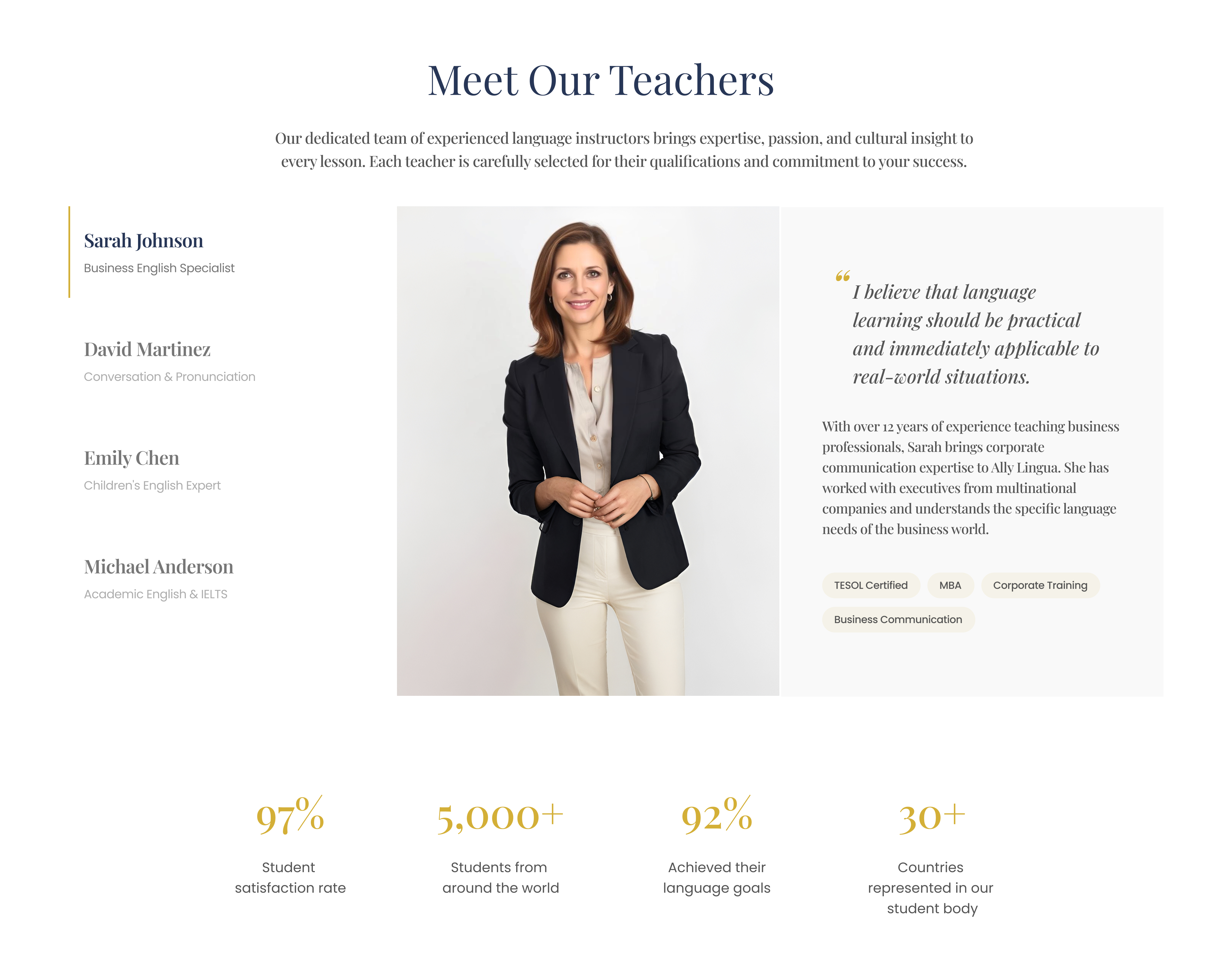
Designed Named teachers with specific credentials replace generic testimonials |
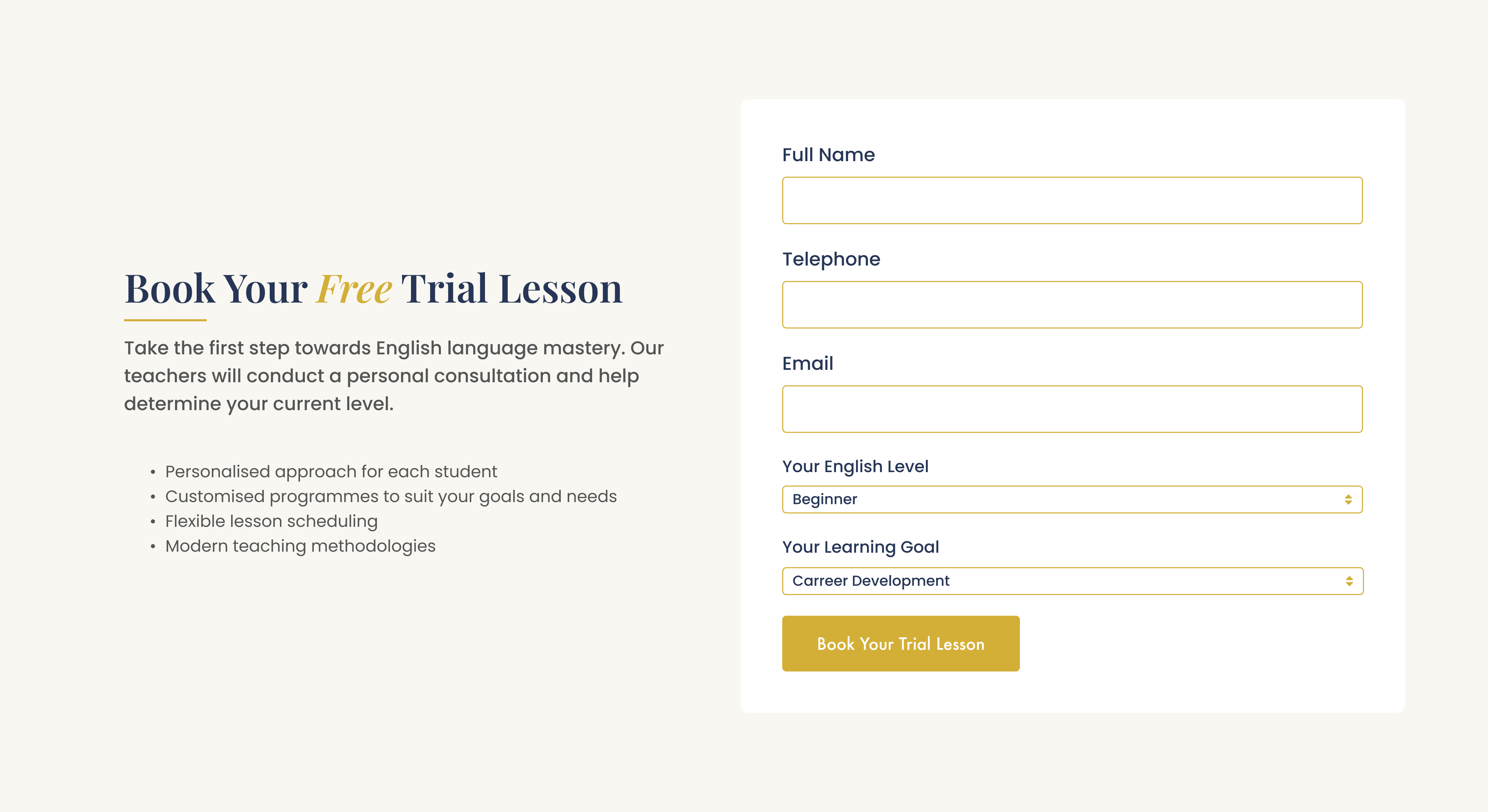
Designed 5-field form framed as "personalised consultation" not a sales call |
Each HMW question was translated directly into a design decision -- not left as abstract intent. Every one of these questions has a visible answer somewhere in the final product.
Two pages, deliberately minimal. The architecture is built around the trust journey -- every path leads to either the courses page or the free trial booking. No dead ends, no unnecessary navigation.
Two user types, two paths, one shared conversion goal. The flows were designed to be short and purposeful -- every step earns the next one.
A complete editorial design system -- tokens, typography, and components -- built to convey premium positioning before a single line of copy is read. The visual language does positioning work independently of the content.
Playfair Display
H1-H3 · Serif · Trust + Premium
Cormorant Garamond
Accent · Quotes · Elegance
Poppins
Body · UI · Labels · Readability
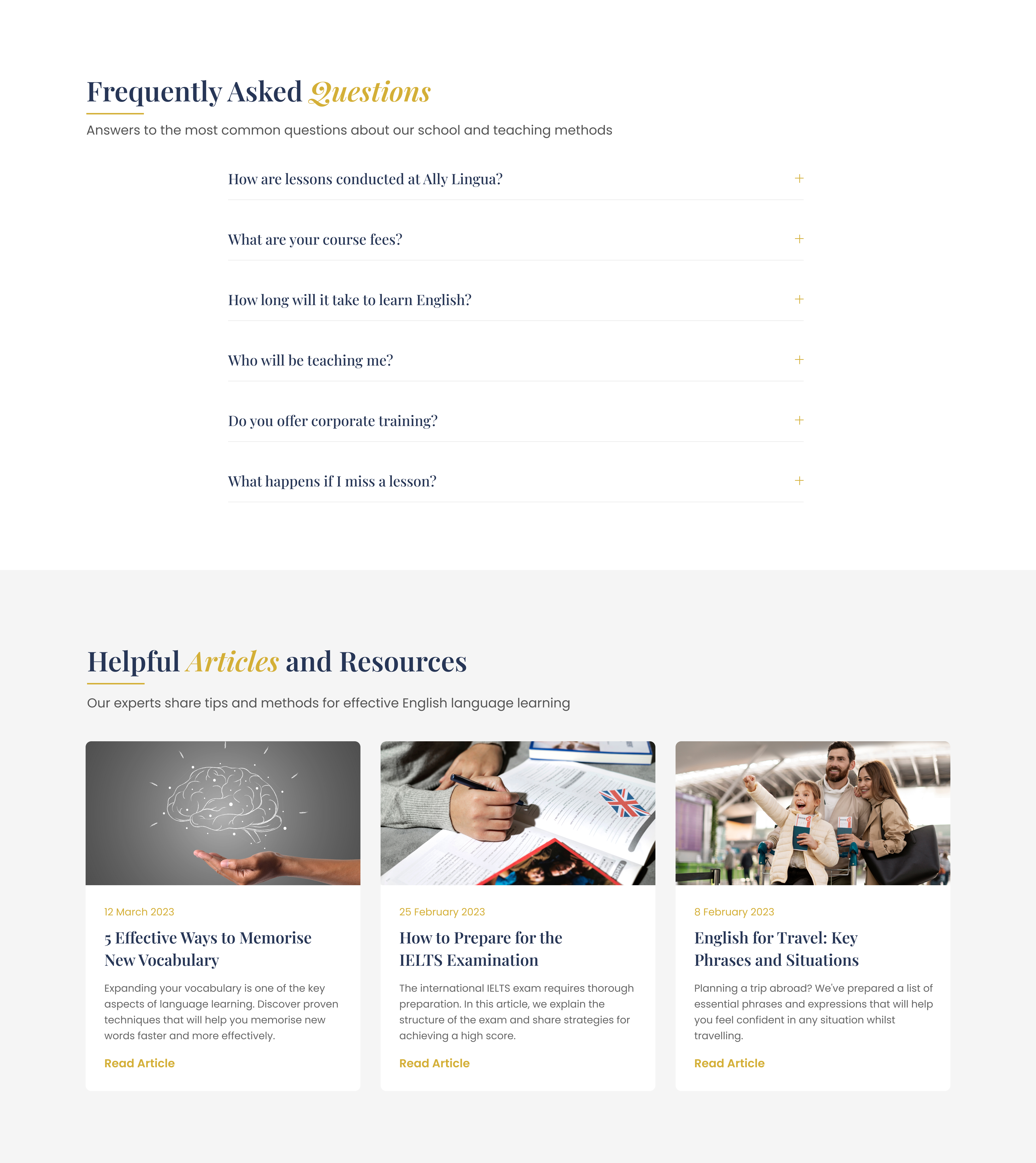
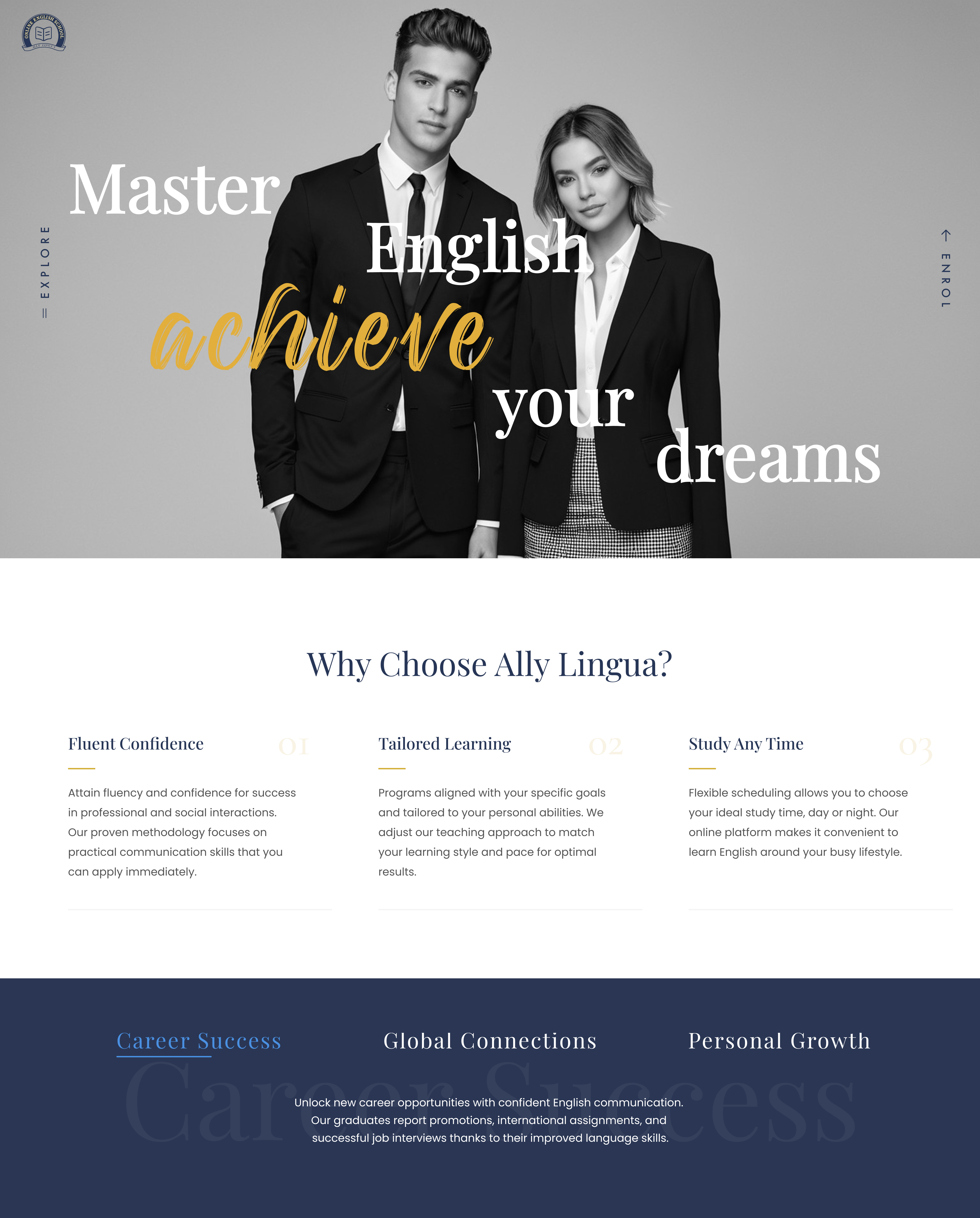
Every section designed to answer a specific question in the visitor's trust journey -- from first impression to booking.
A complete digital identity built from zero -- designed to compete with established online schools from day one.
Senior design is about decision-making under constraints -- what got built, what got cut, and why.
The school had no images of teachers, lessons, or the learning environment. In education, photography is the primary trust signal. Its absence is not a minor gap -- it is a structural problem that the design had to compensate for actively.
The layout was architected to be photography-ready -- image zones with defined proportions and placeholder states that do not look empty. A photography brief was included in the handoff. The site upgrades dramatically when real images are added, with zero redesign required.
A new school has no reviews, no ratings, no case study students. Testimonials are the most effective trust signal in education. Starting without them is a significant disadvantage that the design had to compensate for with other means.
Social proof was replaced with specificity. Named teachers with real credentials, CEFR-mapped programs, methodology stat blocks. The design signals expertise through precision -- an approach that holds up even as real testimonials are collected and added over time.
Maintaining two languages in a static HTML/CSS/JS build means duplicating files manually. Without a CMS or i18n library, this creates editing overhead and synchronisation risk as content evolves and grows.
A file-duplication architecture was chosen -- separate RU and EN HTML files with a clean redirect script. This sacrifices edit efficiency for zero external dependencies and fast load performance. A migration path to a CMS was documented for the next phase.
A fully online school ideally has an integrated booking calendar, payment processor, and student portal. None of these existed in scope -- nor did the backend infrastructure needed to support them at launch stage.
The free trial form collects enough information for a manual follow-up call. This is intentional. For the launch phase, human-led onboarding creates a better first impression than a clunky automated system. Automation is the correct next step once students exist to automate for.
Russian-speaking expats live in two worlds simultaneously -- their culture of origin and their adopted country. The bilingual design is not just functional. Russian as the primary language says: I understand where you are from. English as the product says: I know where you are going. That duality is the product itself.
Going editorial and premium when the EdTech category defaults to bright rounded sans-serifs was not just a style preference -- it was a deliberate positioning decision. The visual language signals that this school takes itself seriously, which makes educated, discerning users take it seriously too.
No photography. No testimonials. No student stories. The architecture had to be honest about what exists and confident about what will come. Designing photography-ready zones rather than placeholder-filled layouts means the site improves dramatically as real content is produced -- without a redesign.
Living across three countries gave direct access to the expat experience that no secondary research could replicate. Understanding that moving abroad is emotionally disorienting -- and that English fluency feels like control over your own life -- shaped every CTA, every headline, and every piece of microcopy. The best research is sometimes lived experience.